

Ending the Sector-51 Street Scramble
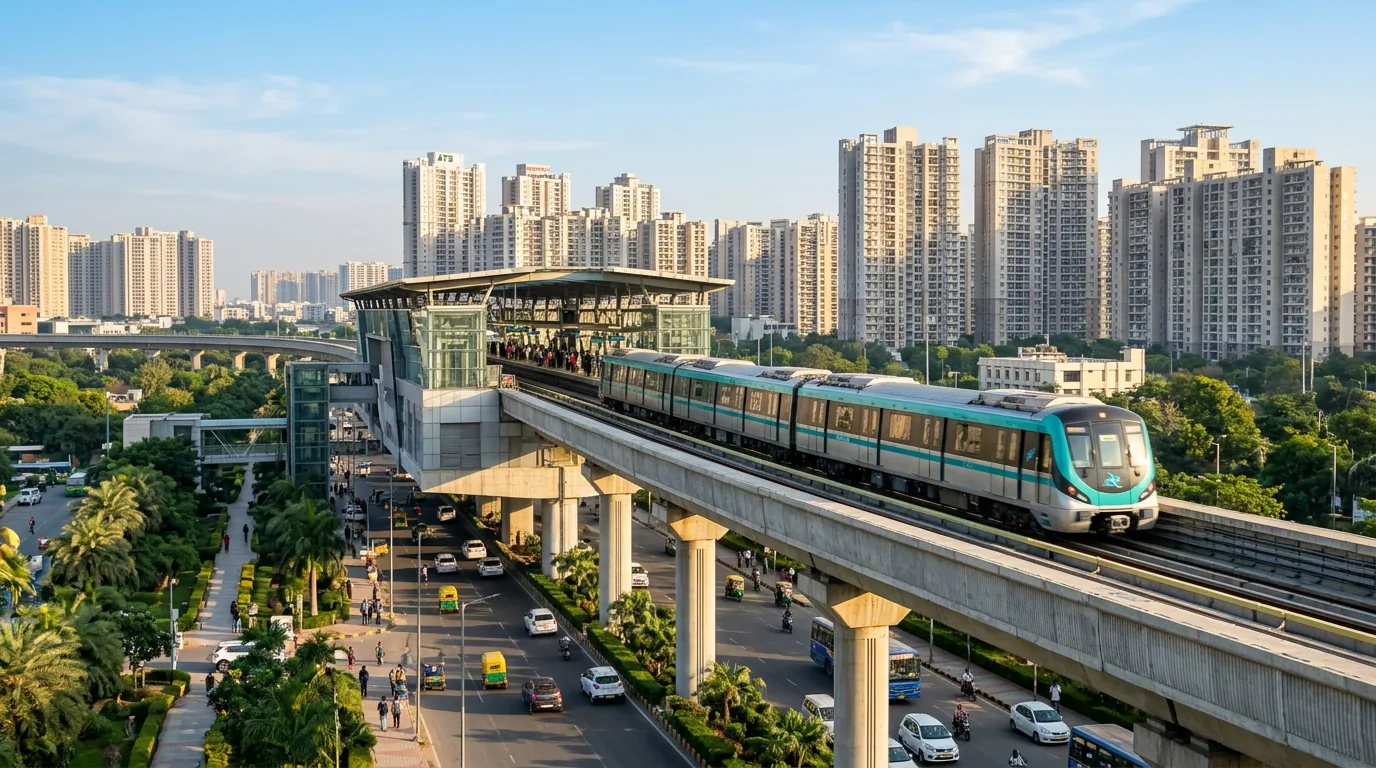
For years, crossing between Delhi and Greater Noida West by metro involved a frustrating architectural mismatch. Passengers riding Delhi Metro’s high-frequency Blue Line reached Sector-52, exited street-side into traffic, walked outside past hawkers and e-rickshaws to reach the Aqua Line’s Sector-51 station, and cleared baggage security a second time before resuming their trip.
Cabinet approval on November 11, 2026 targets that bottleneck head-on. The sanctioned 8.449 km elevated viaduct stretches east from Sector-51 across five elevated stations to Greater Noida Sector-04, bringing the operational Noida–Greater Noida network to 71.878 km. Crucially, the route builds a direct rail interchange with the Blue Line at Noida Sector-61, turning two neighboring networks into one continuous transit fabric.
When High-Rise Growth Outpaced Mass Rail
Urban buildup in Greater Noida Sector-04—anchored by sprawling developments such as Gaur City 1 and 2 alongside dense neighboring clusters like Cleo County in Sector-122—scaled dramatically faster than fixed transit corridors. Hundreds of thousands of families moved in relying almost exclusively on private vehicles, office shuttles, and informal shared autos battling peak bottlenecks toward Delhi and Sector-62.
Official Press Information Bureau route disclosures highlight how tightly the new viaduct tracks existing daily destinations rather than speculative empty plots: corporate parks including Tech Mahindra and TCL Tech in Sector-60 and the Oil Industry Development Board (OIDB) in Sector-73 sit beside IKEA at Sector-51, Anthurium Mall, Gaur City Mall, Blue Sapphire Mall, Delhi Public School at Sector-122, and four major clinical centers—Cloud9 (Sector-51), Kailash Hospital, and Rama Hospitals at Sectors 62 and 70.
"Operationalizing the 8.449 km corridor pushes Noida and Greater Noida to 71.878 km of active metro lines while plugging Gaur City directly into Delhi Airport and main rail trunk routes via the Sector-61 Blue Line interchange."
— PIB Delhi Release (Release ID: 2334969, November 11, 2026)
Checking the Engineering Math: ₹283 Crore per Kilometer
Costed at ₹2,390 crore across 8.449 km—roughly ₹283 crore per kilometer—the extension stays firmly inside conventional Indian elevated-viaduct capital costs. Elevated piers run along wide master-planned sector avenues rather than requiring underground tunnel boring beneath dense heritage neighborhoods, saving years of utility relocation and keeping capital intensity manageable.
At the same time, urban construction poses immediate local trade-offs. Erecting piers and concourses down busy Sector-51–Sector-73–Gaur City roadways will temporarily compress carriageway lanes during peak office shifts, meaning surface traffic discipline during civil work matters directly for commuter patience and winter roadside dust control.
Beyond Rails: Fare Parity and Feeder Execution Decide Ridership
Building trackage only delivers maximum ridership when ticketing and first-mile access stop behaving like separate municipalities. Once Noida Sector-61 opens as an interchange node, riders need frictionless unified smart-card and QR fare integration between NMRC’s Aqua Line and DMRC’s Blue Line without double base-fare penalties.
Equally decisive will be residential repricing around the five upcoming elevated stations and reliable last-mile shuttle buses linking interior Greater Noida West sectors to Sector-04. Watch upcoming civil tender schedules, Sector-61 unified concourse engineering specs, and integrated feeder bus routing over the next year to gauge how quickly the ₹2,390-crore asset pays back surface commuters.